
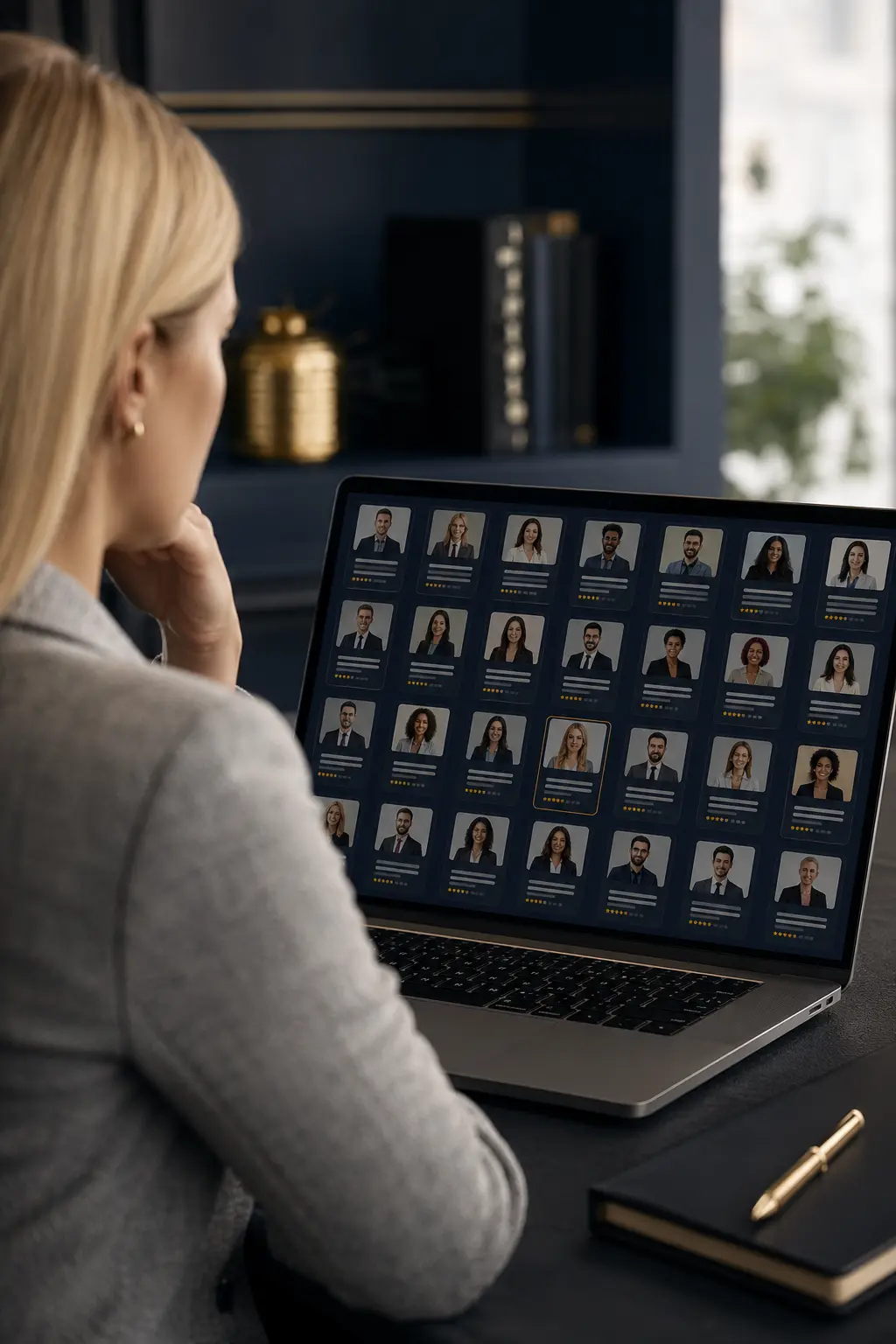
Expert witness directories are easy to forget.
A profile gets created during a marketing push. Another appears through a professional association. A third is added several years later. Eventually, no one remembers exactly what information each one contains.
Meanwhile, your career continues moving.
You change companies. Your title changes. You add certifications. You stop offering one service and begin focusing on another. Your website gets updated.
The directories often do not.
The result is a fragmented online identity.
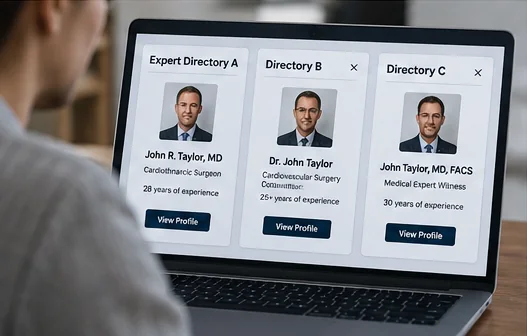
Three profiles. Three different versions of the same expert.
Consider this fictional example.
Directory A
John R. Taylor, MD
Cardiothoracic Surgeon
28 years of experience
Directory B
Dr. John Taylor
Cardiovascular Surgery Consultant
25+ years of experience
Directory C
John Taylor, MD, FACS
Medical Expert Witness
30 years of clinical experience
None of those descriptions necessarily appears problematic.
But an attorney comparing them may reasonably wonder:
- What is the expert’s actual professional title?
- Is the experience 25, 28, or 30 years?
- Is the expert still practicing clinically?
- Why is the fellowship credential missing from some profiles?
- Which biography is current?
That uncertainty is avoidable.
Why directory inconsistencies happen
Usually there is no dramatic explanation.
They happen because different profiles were created at different times.
| Year | Change |
|---|---|
| 2016 | First directory profile created |
| 2018 | New professional title |
| 2020 | Website redesigned |
| 2022 | Additional certification earned |
| 2024 | Expert changes employer |
| 2026 | Old directories still contain the 2016 biography |
Directory information often becomes inaccurate gradually rather than through one obvious mistake.
Nothing went wrong in a single moment. The information simply drifted apart.
The hidden problem is not the directory
The real issue is that a directory profile can become part of the public information used to understand your professional identity.
Search engines may find it.
AI assistants may find it.
Potential retaining counsel may find it.
Opposing counsel may find it.
Someone researching you may see an old directory before they ever reach your own website.
That is why directories should be treated as extensions of your professional presence rather than isolated marketing listings.
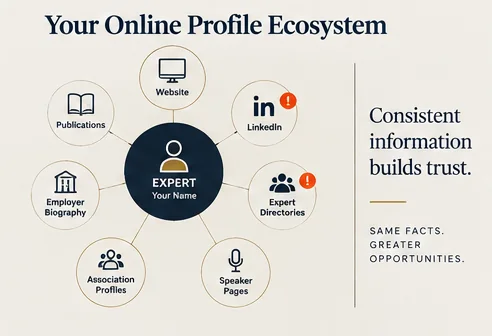
You do not need every profile to use identical marketing copy. You do need the underlying facts to agree.
What should remain consistent?
There are several pieces of information worth standardizing.
Professional name
Decide how you normally present your professional name.
For example:
- Maria Johnson, MD
- Maria E. Johnson, MD, FACP
Minor variations are normal, but excessive differences can make profiles appear disconnected.
Current professional title
Your primary professional role should be accurately described. If an old listing still presents a previous position as current, update it where possible.
Employer or practice
Old affiliations are one of the easiest inconsistencies to miss, particularly on profiles that have not been touched for several years.
Location
Your office location, service area, or primary practice location should reflect current circumstances.
Credentials
Major licenses, certifications, appointments, and professional credentials should be accurate and current.
Areas of expertise
Your terminology does not need to be identical everywhere, but it should describe substantially the same professional focus.
Years of experience
This deserves particular attention.
Statements such as:
- 20 years of experience
- More than 20 years of experience
- Practicing since 2004
do not age in the same way.
Using a specific starting year can sometimes reduce maintenance and ambiguity.
The consistency rule
Different presentation is fine. Different facts are not.
What does not need to be identical?
Consistency does not mean copying and pasting exactly the same biography into every directory.
Different platforms serve different purposes.
One profile may allow 100 words. Another may allow 1,000. A specialist directory may require detailed expertise categories. LinkedIn may emphasize your broader professional career. Your own website may offer the most complete version.
The wording can change.
The facts should not.
How to perform a directory audit
Start by searching your name rather than trying to remember every profile you have ever created.
Try searches such as:
- “Your Name” expert witness
- “Your Name” consultant
- “Your Name” directory
- “Your Name” biography
- “Your Name” + your specialty
Record every relevant result.
Create a simple profile inventory
A spreadsheet is enough.
| Platform | Information correct? | Login available? | Action |
|---|---|---|---|
| Website | Yes | Yes | None |
| Mostly | Yes | Update title | |
| Directory A | No | Yes | Rewrite profile |
| Directory B | No | No | Contact support |
| Professional association | Mostly | No | Request update |
A simple inventory turns a vague visibility problem into a manageable maintenance process.
Prioritize profiles that actually matter
You may discover dozens of references to yourself.
Not every one deserves equal attention.
Start with sources that:
- Rank prominently for your name
- Are commonly used by attorneys
- Contain substantial professional information
- Are clearly outdated
- Directly contradict your primary website or CV
This keeps the project manageable.
What if you cannot edit a listing?
Not every directory provides login access.
In that case:
- Contact the directory or site owner
- Request a correction
- Provide the corrected information clearly
- Save a record of the request
- Follow up if the page remains unchanged
Some old profiles may never disappear entirely.
The goal is to correct what reasonably can be corrected and ensure your strongest current sources are accurate.
A quarterly 15-minute check can prevent years of drift
Profile consistency does not need to become a major recurring project.
Once the initial cleanup is complete, create a short review process.
Every few months:
- Search your name
- Review the most prominent results
- Check your major directories
- Update new credentials or appointments
- Remove outdated language
- Record new professional profiles that appear
Fifteen minutes of maintenance is considerably easier than reconstructing years of conflicting information later.
Directory audit checklist
- Professional name is presented consistently
- Current title is accurate
- Current employer or practice is correct
- Location information is current
- Credentials are accurate
- Specialty descriptions reflect current work
- Years of experience are presented consistently
- Contact details work
- Old services have been removed
- Major profiles align with the current CV
Your directory profiles should reinforce each other
Every professional listing contributes a small piece to the picture someone forms of you.
When those pieces align, the research process feels straightforward.
When they contradict each other, they create unnecessary questions.
For an expert witness, consistency is not merely a branding concern. It is part of maintaining a professional record that can withstand scrutiny.

Written by
Pert Cristian
Web developer focused on creating fast, accessible, and easy-to-use websites with clean, maintainable code. I work across design, development, performance, and responsive implementation to build reliable websites that are simple to manage and built to last.
On this page
How does your practice read to an attorney?
Send us your site, CV, or profiles. We reply with the first three things we would flag.
Ask for a reviewReview