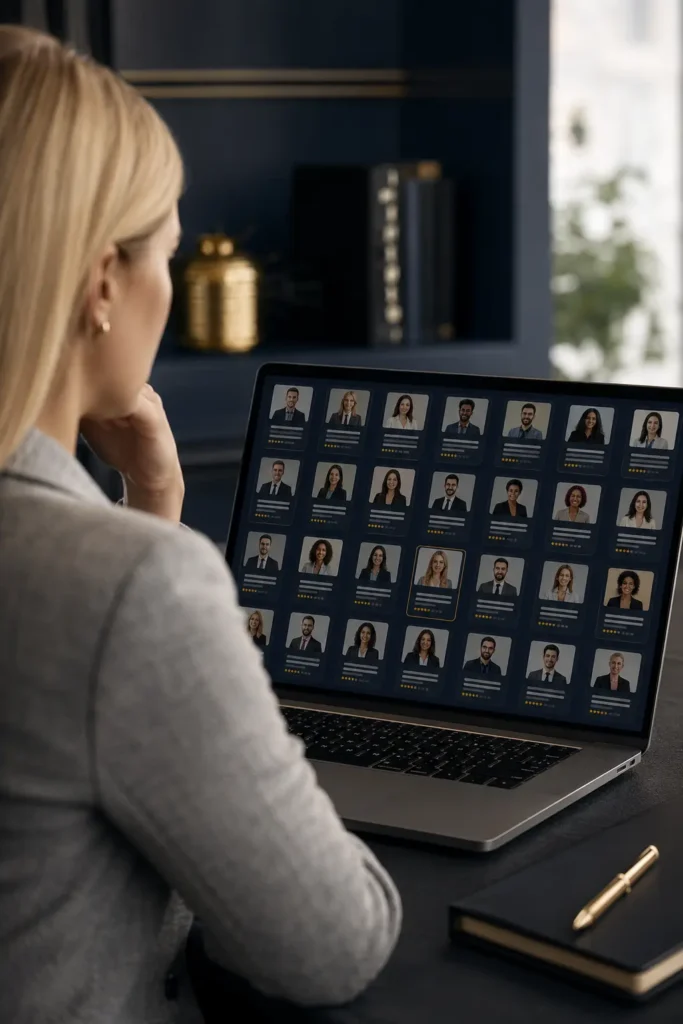

An attorney looking for an expert witness no longer has to begin with a traditional Google search.
They can ask an AI assistant a question such as:
Who are experienced pediatric neurologists who provide expert witness services?
Or:
Find an engineering expert with experience in industrial equipment failures.
Within seconds, an AI system may summarize possible candidates, identify professional websites, reference directories, and surface information that can help an attorney begin the vetting process.
That introduces a new visibility question for expert witnesses.
It is no longer enough to ask:
Where do I rank?
You may also need to ask:
What does the information available online allow an AI system to understand about me?

AI visibility begins with ordinary information
AI assistants do not magically know your professional history.
They depend on information available through sources such as:
- Your professional website
- Professional biographies
- Expert witness directories
- Association profiles
- Publications
- Interviews and speaking engagements
- Institutional pages
- Structured website data
- Other publicly available references
When those sources clearly describe who you are and what you do, your professional identity is easier to interpret.
When they contradict each other, the picture becomes less clear.
Consider two hypothetical experts
Expert A
Their online presence consistently says:
- Forensic accountant
- 22 years of experience
- Commercial damages specialization
- Expert witness and consulting services
- Based in Chicago
- Experience in state and federal matters
- Published on business valuation
Expert B
Their online presence includes:
- An outdated employer biography
- A LinkedIn profile with almost no description
- Three directory profiles using different job titles
- A website that says only “financial consulting”
- No dedicated page explaining litigation support work
Which expert is easier for a search system to understand?
The answer does not necessarily tell us who is the better expert. It tells us whose professional information is clearer.
Visibility is not the same as qualification
An expert may be exceptionally qualified while having a weak online presence. Search visibility affects discoverability, not the underlying quality of the expert’s professional experience.
What information should be easy to understand?
Your online presence should answer several basic questions.
| Question | Information that may answer it |
|---|---|
| Who are you? | Full name and professional title |
| What is your field? | Clear specialty description |
| What problems do you work on? | Defined areas of expertise |
| Do you work with attorneys? | Expert witness or litigation support information |
| What supports your expertise? | Credentials, experience, publications, appointments |
| Where do you work? | Geographic or service information |
| How can someone contact you? | A clear contact pathway |
Basic professional information should be clear before advanced AI optimization becomes a concern.
The difference between keyword visibility and professional clarity
Traditional SEO often concentrates on search phrases.
For example:
orthopedic expert witness
That still matters. But modern search systems also attempt to understand relationships between people, organizations, specialties, credentials, publications, and services.
A clear digital identity might connect information such as:
- Dr. Jane Smith
- Orthopedic surgeon
- Shoulder injuries
- Clinical practice
- Expert witness services
- Professional publications
- Medical associations
The clearer those relationships are across credible sources, the easier it becomes to understand what Dr. Smith actually does.
Ask AI systems about your field
One useful research exercise is surprisingly simple.
Use several search and AI tools with questions an attorney might realistically ask.
For example:
- Find a structural engineering expert witness specializing in building failures.
- Who provides expert testimony regarding neonatal neurology?
- Find an expert witness experienced in hospitality industry standards.
- Who are specialists in forensic accounting disputes?
- What should I look for when retaining a trucking safety expert?
Then examine the responses.
You are not simply checking whether your name appears.
Look at:
- Which credentials are emphasized
- Which terminology is repeatedly used
- Which directories or professional sources appear prominently
- Which experts are repeatedly surfaced
- What questions the system suggests asking during vetting
This can help identify gaps in your own professional positioning.
AI visibility is not about writing content for robots. It is about making professional information clear enough that both people and machines can understand it.
What not to do
The growth of AI search will inevitably create bad marketing advice.
Experts should be cautious about strategies such as:
- Publishing hundreds of low-quality AI-generated articles
- Inventing or exaggerating credentials
- Creating fake author profiles
- Repeating “expert witness” unnaturally throughout every page
- Making unsupported claims of authority
- Creating dozens of nearly identical geographic pages
- Writing content about specialties outside your actual expertise
Visibility should not come at the cost of credibility.
For an expert witness, that tradeoff makes particularly little sense.
A better approach
1. Make your website clear
Create pages that accurately explain:
- Your professional background
- Your areas of expertise
- The types of matters you consult on
- Your credentials
- Your publications
- Your speaking engagements
- Your contact information
2. Keep professional profiles aligned
Titles, biographies, employment history, and specialty descriptions do not need to use identical wording, but the underlying facts should agree.
3. Publish useful subject-matter content
Content should demonstrate genuine knowledge rather than merely repeat marketing keywords.
A useful article may explain:
- A frequently misunderstood concept in your field
- A technical issue attorneys commonly encounter
- How professional standards are applied
- What documentation is typically important
- How terminology is used within your specialty
4. Get the technical basics right
Good technical foundations still matter. These include:
- Descriptive page titles
- Logical heading structure
- Accessible HTML
- Useful internal linking
- Structured data where appropriate
- Fast-loading pages
- Pages that search engines can crawl and index
AI visibility checklist
- Is my full professional name used consistently?
- Is my specialty obvious?
- Does my website clearly explain my expert witness work?
- Are my most important credentials visible?
- Do major directory profiles agree with my website?
- Are outdated biographies still appearing online?
- Can search engines access my key pages?
- Is my content specific to my actual expertise?
- Are claims on my website supportable?
- Is there a clear way for an attorney to contact me?
Search is changing. Credibility is not.
The interface through which attorneys discover experts will continue to change.
Traditional search results have expanded to include directories, knowledge panels, featured answers, maps, video, and AI-generated summaries.
The underlying requirement remains remarkably stable:
Credible information needs to exist before it can be discovered.
That makes a sensible AI-search strategy much less exotic than it may first appear.
Build a professional presence that accurately communicates who you are, what you know, and where someone can verify that information.

Written by
Pert Cristian
Web developer focused on creating fast, accessible, and easy-to-use websites with clean, maintainable code. I work across design, development, performance, and responsive implementation to build reliable websites that are simple to manage and built to last.
On this page
How does your practice read to an attorney?
Send us your site, CV, or profiles. We reply with the first three things we would flag.
Ask for a reviewReview